Short answer: Wafeq is a well built accounting platform for Saudi and Gulf businesses. Odoo is a full business system that happens to include accounting. If your work ends at invoices, expenses, VAT returns and payroll, Wafeq will very likely serve you better and faster. If your work involves manufacturing, projects, field service, multi step inventory or a sales pipeline, no accounting platform will close that gap, and paying more for a bigger accounting plan will not change it.
What each product actually is
This is the whole comparison in two sentences, and most articles on the subject skip it.
Wafeq is a cloud accounting and e-invoicing platform built for the Saudi market, with UAE and Egypt coverage as well. It publishes a deliberately narrow product boundary: invoicing, purchases and expenses, VAT returns in the Authority format, inventory of products and services, payroll, and a reporting library. That narrowness is a feature, not a shortcoming. It is why the product is quick to learn and quick to deploy.
Odoo is a modular business platform. Accounting is one app among many, sharing a database with sales, purchase, inventory, manufacturing, projects, HR, point of sale, ecommerce, maintenance and field service. You install what you need and leave the rest off. That breadth is also why an Odoo rollout takes more thought than signing up for a SaaS accounting plan.
So the honest framing is not which one is better. It is which category of product does your business need this year and next.
Published pricing, side by side
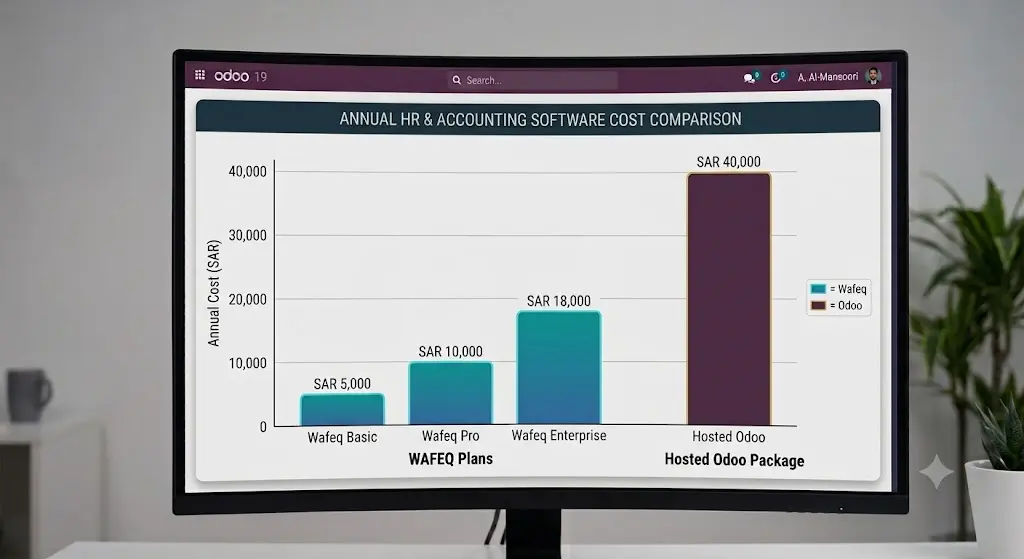
Wafeq publishes its plans openly, which is more than most vendors in this market do. The figures below are the plan prices Wafeq has published for Saudi Arabia, quoted per month.
| Plan | Published price | Rough annual equivalent |
|---|---|---|
| Entry plan | From SAR 99 per month | About SAR 1,188 per year |
| Professional | SAR 129 per month | About SAR 1,548 per year |
| Premium | SAR 159 per month | About SAR 1,908 per year |
| Elite | SAR 349 per month | About SAR 4,188 per year |
| Ultimate | SAR 799 per month | About SAR 9,588 per year |
| Enterprise | Quoted on request | Not published |
For comparison, our hosted Odoo small business package starts at SAR 400 per year with additional users at SAR 150 per year, covering both e-invoicing phases. Full pricing sits on the small business package page, and the wider market picture is in our guide to what ERP actually costs in Saudi Arabia.
Two warnings before you use that gap as your only reason to decide. First, published SaaS prices change, so verify both sides at source before committing. Second, a lower subscription is not automatically a lower total cost. Software you configure badly is more expensive than software you rent, whatever the invoice says.
Where the two products overlap
For a services company or a small trading business, the overlap is wide enough that either product will do the job:
- Sales invoices, credit notes, quotations and purchase orders
- ZATCA compliant e-invoicing including the second phase
- VAT at 15 percent and a return in the Authority format
- Customer and supplier ledgers, ageing and statements
- Profit and loss, balance sheet, cash flow and trial balance
- Multi currency, multi branch and multiple establishments
- Basic stock of products with quantity on hand
If that list is your whole business, stop reading comparison articles and pick on usability and support. Both will work.
Where Wafeq is genuinely the better choice
Saying an ERP wins everywhere would be a sales pitch, not a comparison. There are real cases where Wafeq is the right answer and we would say so to a prospect.
- You need to be live this week. A SaaS accounting sign up is measured in hours. An Odoo rollout, even a small one, is measured in days at minimum.
- Nobody in the company will own the system. Odoo rewards a business that has someone willing to configure it. Wafeq is designed to work without that person.
- You are one to five people doing services work. The operational apps that justify an ERP simply do not apply to you yet.
- Automated Arabic invoice capture matters to you. Wafeq has invested heavily in AI driven document capture for Arabic invoices, and markets it as a headline feature.
- Your accountant already works in it. An accounting office that knows a platform well is worth more than a feature list. This is the single most underrated factor in the whole decision.
Where Odoo is the better choice
The dividing line is not accounting depth. It is everything that happens before the invoice.
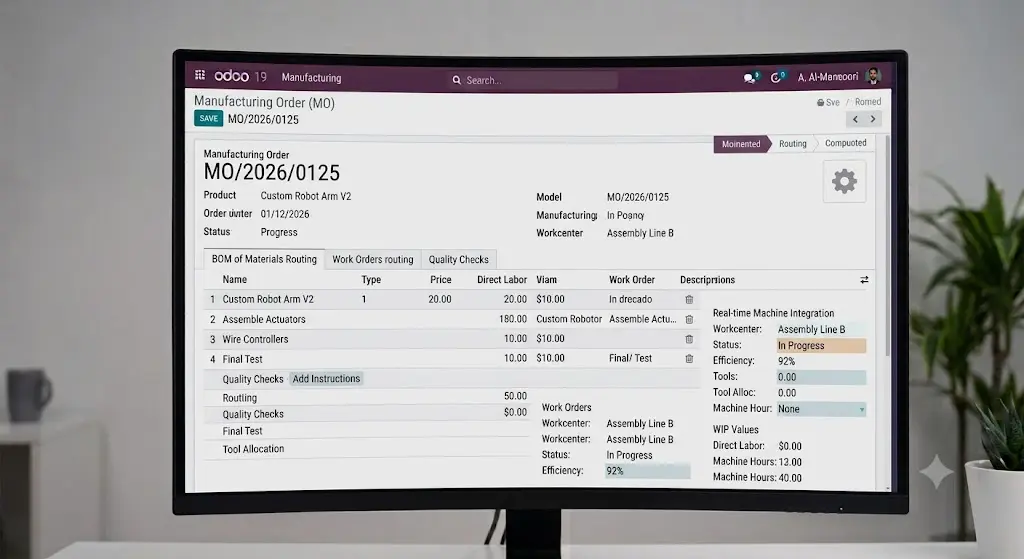
- You make things. Bills of materials, work orders, routings, scrap, work in progress and real manufacturing cost. No accounting platform covers this, at any plan level.
- Inventory is more than a counter. Multi warehouse, internal transfers, putaway and removal strategies, lots and serial numbers, expiry dates, landed costs, replenishment rules. Accounting products track quantity. ERPs run a warehouse.
- You run projects. Timesheets to billing, budget against actual, milestone invoicing and profitability per project rather than per company.
- You want the pipeline in the same database. Lead to quotation to sales order to delivery to invoice, without a second tool and a nightly sync.
- You are hitting the edges of your process. Approval flows, custom fields, custom reports, a field service app, a portal for customers. Odoo is open source and extensible by design. A closed SaaS product is not, and that is a deliberate choice on their part, not a defect.
- You want to own your data and your hosting. With hosted Odoo you can take a full database backup and leave whenever you want.
The four questions that actually settle it
- Does anything happen in your business between the order and the invoice? Assembly, production, picking across warehouses, a project plan, a technician visit. If yes, you need an ERP. If the invoice is the work, you need accounting software.
- Will you configure it, or does it need to work out of the box? Answer this honestly about your team as it is today, not as you hope it will be.
- What does your accountant use? Migration cost is real, and so is the cost of an accountant learning a new system on your time.
- Where will you be in twenty four months? Migrating systems at forty employees costs far more than choosing correctly at eight. But over buying at eight also has a cost. Be realistic in both directions.
A note on switching
If you are already on Wafeq and outgrowing it, the migration is normally straightforward. Chart of accounts, customers, suppliers, products and opening balances export cleanly, and historical invoices are usually best left in the old system as an archive rather than re-imported. The part that takes time is not the data. It is agreeing how your operational process should look once you have apps that can model it properly.
Frequently asked questions
Is Odoo compliant with ZATCA phase two?
Yes, when it is configured and onboarded correctly. The full sequence is covered in our Fatoora integration guide, and the things that commonly break are in the troubleshooting guide.
Is Wafeq cheaper than Odoo?
Not on the figures above, if you compare a hosted Odoo package against a Wafeq subscription. But price per year is the wrong single measure. Compare the total of subscription, setup, training and the cost of the work the system cannot do.
Does Odoo handle Saudi payroll, GOSI and wage protection?
Payroll in Odoo is configurable to Saudi rules, including the GOSI contribution base and end of service. Wage protection file generation depends on how your instance is set up and which bank you use. We covered the detail in Saudi payroll in Odoo.
Can I try Odoo before committing?
Yes. A working instance with your own chart of accounts and a handful of real invoices tells you more in an afternoon than any comparison table, including this one.
What if I only need e-invoicing compliance and nothing else?
Then buy the smallest thing that gets you compliant. Start with the complete ZATCA requirements guide and work out your actual obligation before you buy anything.
Where to go next
If you are comparing more than two products, the full comparison against Qoyod, Wafeq, Daftra and Zoho Books puts all of them in one table. If Qoyod is the other name on your shortlist, we covered that pairing in detail in Odoo vs Qoyod.
Pricing and feature information about other vendors is taken from their own published material and is subject to change without notice. Verify current figures at source before making a purchase decision. We provide managed Odoo hosting and implementation, so treat this comparison as informed but not disinterested, and check the claims that matter to you.