Short answer: a small Saudi business that only issues invoices and files VAT can run on SAR 400 to SAR 1,400 per year. A business with branches, a cashier and payroll typically lands between SAR 3,000 and SAR 9,000 per year on the popular cloud accounting platforms, and closer to SAR 1,200 on a hosted Odoo. The gap is almost never the headline price. It is the add-ons and the tier gating underneath it.
Why the published price is never the price you pay
Every cloud accounting vendor in Saudi Arabia advertises an entry plan. Almost none of them let a real operating business stay on it. Three things push you up:
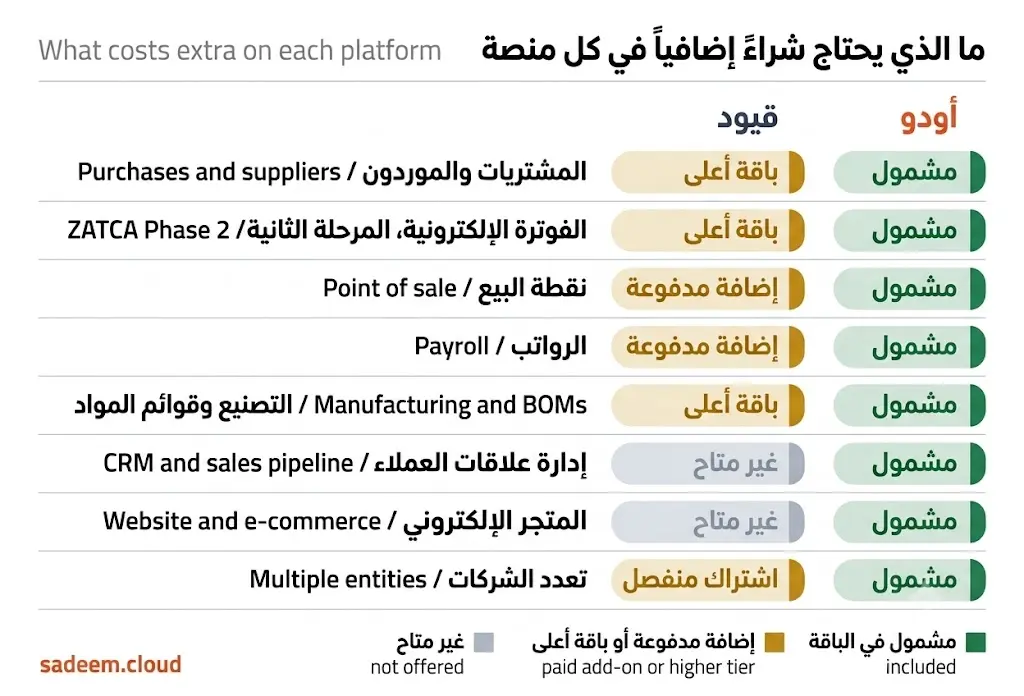
- ZATCA Phase 2 is usually gated to a higher tier. If you are required to integrate with Fatoora, the entry plan is simply not an option, no matter how small you are.
- Users, branches, cashiers and employees are priced separately. These are not luxuries. A shop with one owner, one accountant and one cashier already needs three of them.
- Each commercial register needs its own subscription. Two entities means paying twice, in full.
So the honest way to budget is to price your actual configuration, not the plan name.
What the Saudi market actually charges
The figures below are annual, in Saudi Riyals, taken from each vendor's own published pricing and help documentation at the time of writing. Always confirm current rates directly with the vendor before you commit.
Qoyod
| Plan | Annual (incl. VAT) | Users | Locations | ZATCA Phase 2 |
|---|---|---|---|---|
| Basic | SAR 1,380 | 1 | 1 | Not available |
| Pro | SAR 2,070 | 3 | 3 | Available |
| Advanced | SAR 3,795 | 5 | 5 | Available |
Add-ons, priced annually and excluding VAT: extra user SAR 240, extra location SAR 480, point of sale SAR 600 per cashier user, payroll SAR 120 per employee. Point of sale and payroll are not bundled into any plan.
Two details in the Basic plan matter more than the price. It has no purchasing module at all, meaning no suppliers, no purchase invoices and no purchase orders. And it does not include Phase 2 integration. For most businesses that trade physical goods, Basic is not a starting point, it is a demo.
Wafeq
| Plan | Annual | Notes |
|---|---|---|
| Starter | SAR 1,190 | 2 users, invoicing and expenses, no Phase 2 integration |
| Plus | SAR 1,430 | Phase 2 integration, purchase bills and orders, projects |
| Premium | SAR 2,390 | Higher tier features |
Wafeq does not offer a point of sale. If you run a shop, restaurant or clinic reception, you will be buying a second system for the till and paying for the integration between them.
Hosted Odoo (Sadeem plans, for reference)
| Plan | Annual | Users | What is included |
|---|---|---|---|
| Starter | SAR 400 | 1 | Invoicing, customers and vendors, ZATCA Phase 1 and 2 |
| Advanced | SAR 800 | 5 | Sales, purchases and inventory on top |
| Point of Sale | SAR 1,200 | 10 | Point of sale and restaurant POS on top |
Extra user SAR 150 per year. Implementation and training, if you want it, SAR 70 per hour.
Two worked examples
Plan names are meaningless until you price a real business. Here are two configurations that cover most of the Saudi small business market.
Example 1: a services company, one user, Phase 2 required
A consultancy or agency. One person issuing invoices. No stock, no cashier, no payroll module needed. The only hard requirement is Fatoora integration.
| Option | Why this tier | Annual cost |
|---|---|---|
| Qoyod | Phase 2 forces Pro even for a single user | SAR 2,070 incl. VAT |
| Wafeq | Phase 2 forces Plus | SAR 1,430 |
| Hosted Odoo | Phase 2 included on the entry plan | SAR 400 |
Note what happened. The business needs one user and one feature, and on two of the three platforms it pays for a mid tier it will never fully use, purely because compliance sits above the entry line.
Example 2: a retail business, 3 users, 2 branches, 1 cashier, 5 employees on payroll
This is the typical Jeddah shop or small chain. Now the add-ons start counting.
| Line item | Qoyod | Hosted Odoo |
|---|---|---|
| Base plan | Pro, SAR 1,800 excl. VAT | Point of Sale plan, SAR 1,200 |
| Users | 3 included | 10 included |
| Branches | 3 included | Included |
| Point of sale | SAR 600 per cashier user | Included |
| Payroll, 5 employees | SAR 600 | Included |
| Annual total, excl. VAT | SAR 3,000 | SAR 1,200 |
| Over three years | SAR 9,000 | SAR 3,600 |
Wafeq is not in this table because it has no point of sale, so the comparison would not be like for like. A retail business on Wafeq needs a second vendor for the till.
The costs nobody puts on the pricing page
Subscription is the visible part. Budget for these too, because they are the line items that turn a SAR 1,500 decision into a SAR 15,000 one.
| Cost | Typical range in Saudi Arabia | When it hits you |
|---|---|---|
| Setup and chart of accounts | SAR 0 to 5,000 | Month one, unless you do it yourself |
| Opening balances and data migration | SAR 1,000 to 6,000 | Month one, scales with how messy the old books are |
| Training | SAR 70 per hour and up | Month one, and again every time you hire |
| A second subscription per commercial register | Full price again | The day you open a second entity |
| POS hardware | SAR 1,500 to 6,000 per till | Before you open |
| Integration to a store or bank | SAR 0 to 3,000 | Whenever you connect Salla, Zid or similar |
| Getting your data out | Time, or a migration fee | The day you want to leave |
That last row is the one people discover too late. On a closed platform, the practical cost of switching is high enough that it functions as a price increase you cannot refuse at renewal. On an open source system your database is standard PostgreSQL and the data is exportable, which is a real financial characteristic and not just a philosophical one.
How to build a number you can trust
Write down these six answers before you look at a single pricing page:
- How many people need to log in? Count the accountant and the cashier, not just the owner.
- How many branches or warehouses? Locations are billed on most platforms.
- Do you buy from suppliers and hold stock? If yes, entry plans are mostly out.
- Do you need Phase 2 integration now? If yes, price the tier that actually includes it.
- How many employees will go on payroll? Per employee pricing is common.
- What will you need in two years? Manufacturing, projects, a CRM, a second entity. Adding a module is cheap. Migrating systems is not.
Then multiply your answer by three years, not by one. Almost every bad software decision in this market looks fine in year one.
When paying more is the right call
To be fair to the accounting platforms: if your business is genuinely just invoicing and VAT, and you want a local Arabic support team on the phone with zero setup thinking required, Qoyod and Wafeq are polished, well supported and quick to start. That convenience is worth real money to a business without technical staff, and pretending otherwise would be dishonest.
The calculation changes when you hold inventory, run a till, employ people, or expect to add a second entity. At that point you are no longer buying accounting software, you are buying an ERP one add-on at a time, at ERP prices, without ERP capability.
Frequently asked questions
Is there a genuinely free option that is ZATCA compliant?
Free tiers exist but generally cap invoice volume and exclude Phase 2 integration. For real commercial use in Saudi Arabia you will be on a paid plan. Self hosting Odoo Community is free in licence terms, but you then carry the server, backups, security and updates yourself, which is a cost in either money or hours.
Are the advertised prices inclusive of VAT?
It varies by vendor and this is a frequent source of confusion. Qoyod publishes plan prices including the 15 percent VAT but prices add-ons excluding it. Always ask which one you are looking at before comparing two quotes.
Does a bigger annual price mean fewer surprises?
Not reliably. What reduces surprises is checking whether users, locations, point of sale and payroll are inside the plan or billed on top. A cheaper plan with four metered add-ons usually costs more than a dearer plan with none.
What does implementation actually cost?
For a small business with clean books, a day or two of help is normally enough. Where projects run long and expensive, it is almost always because the old data was disorganised, not because the software was difficult.
Related reading
Full feature and price comparison: Odoo against the Saudi accounting apps
The complete ZATCA e-invoicing requirements guide
Odoo small business plans from SAR 400 per year
Prices are collected from each vendor's public pricing and help documentation at the time of writing and change without notice. This article is general information, not financial or tax advice. Confirm current rates with each vendor before making a purchasing decision.