Short answer: Qoyod is accounting software. Odoo is an ERP that includes accounting. If your business is invoices, VAT and reports, Qoyod is a clean and well supported choice. If you buy from suppliers, hold stock, run a till, employ people or expect a second entity, you will outgrow it, and the cost of arriving there through add-ons is higher than starting on an ERP. This guide sets out where each one actually wins.
They are not the same category of product
Most comparisons treat this as a head to head between two similar tools. It is not. Qoyod is built to do one job extremely well: keep the books of a Saudi business and satisfy ZATCA. Odoo is a modular business system where accounting is one app among dozens that share a single database.
That difference explains almost every practical distinction below, including the pricing.
What Qoyod genuinely does well
Anyone telling you Qoyod has no advantages is selling something. It has real ones:
- Arabic first, built in Riyadh. The interface, the documentation and the support team are native to this market. Nothing is a translation of a Western product.
- Nothing to configure before you start. Sign up and issue an invoice the same hour. There is no server, no chart of accounts decision, no implementation partner.
- ZATCA is their core business. Regulatory changes are handled by a team whose entire product depends on getting them right, quickly.
- Local support that answers. Phone and WhatsApp support in Arabic, during Saudi working hours, is genuinely valuable to a business with no IT staff.
- Predictable for simple businesses. If your needs never change, neither does your bill.
For a consultancy, a small agency or a service business that will never hold inventory, that package is difficult to argue against.
Where the ceiling is
The constraints are structural rather than defects. Qoyod is scoped to accounting, so anything outside accounting is either an add-on, a higher tier, or absent.
| Capability | Qoyod | Odoo |
|---|---|---|
| Purchases, suppliers, purchase orders | Not in the entry plan at all | Included from the small business plan |
| ZATCA Phase 2 | From the Pro tier upward | Included on every plan |
| Point of sale | Paid add-on, per cashier user | Included on the POS plan |
| Payroll | Paid add-on, per employee | Included as an app |
| Users | 1 to 5 by tier, then billed per user | 1 to 10 by plan, extra users at low cost |
| Manufacturing and bills of materials | Advanced tier only | Standard app |
| CRM and sales pipeline | Not offered | Standard app |
| Websites and e-commerce | Not offered | Standard app |
| Field service, repairs, subscriptions, rentals | Not offered | Standard apps |
| Custom fields and workflows | Limited to what the product exposes | Extensible without limit |
| Source code and data ownership | Closed platform | Open source, standard PostgreSQL database |
| Multiple entities | Separate paid subscription each | Multi company in one system |
The price, compared honestly
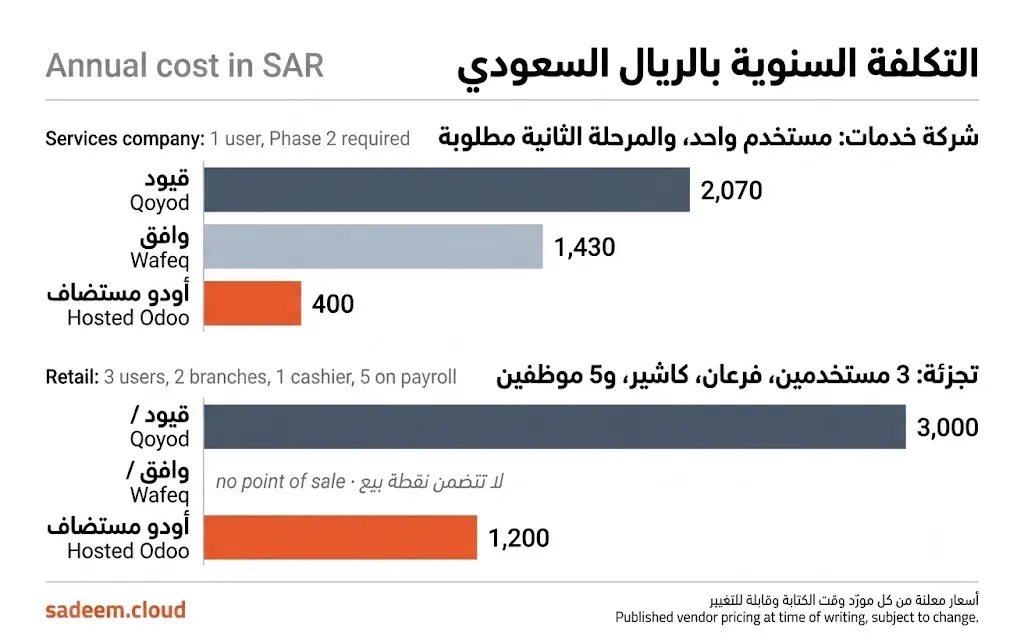
Annual figures at the time of writing. Qoyod plan prices include the 15 percent VAT; Qoyod add-on prices exclude it. Always confirm current rates with each vendor.
| Tier | Qoyod | Hosted Odoo |
|---|---|---|
| Entry | SAR 1,380, 1 user, 1 location, no Phase 2, no purchasing | SAR 400, 1 user, Phase 2 included |
| Growing business | SAR 2,070, 3 users, 3 locations, Phase 2 | SAR 800, 5 users, sales, purchases and inventory |
| With a till | SAR 2,070 plus SAR 600 per cashier | SAR 1,200, POS included, 10 users |
| Payroll for 5 staff | Plus SAR 600 | Included |
| Extra user | SAR 240 | SAR 150 |
| Extra location | SAR 480 | Included |
A retail business with three users, two branches, one cashier and five employees on payroll comes to roughly SAR 3,000 a year excluding VAT on Qoyod, against SAR 1,200 on a hosted Odoo. The difference is not a discount. It is the difference between paying per capability and having the capabilities included. The full arithmetic is in our breakdown of what an ERP really costs in Saudi Arabia.
Three questions that settle it
Skip the feature lists. Answer these:
1. Do you buy from suppliers and hold stock?
If yes, the Qoyod entry plan is out immediately, because it contains no purchasing module. You are comparing the Pro tier upward, and the price gap widens accordingly.
2. Will you have more than three users or three branches?
Metered pricing is fine at small numbers and unpleasant at larger ones. Count who genuinely needs a login over the next two years, including the accountant and every cashier, then price it.
3. Will your business need anything beyond accounting within two years?
A sales pipeline, a website, manufacturing, project costing, a maintenance workflow, a second company. If any of those is likely, note that adding an Odoo app is a configuration change, while adding it to a closed accounting platform means running a second system or migrating entirely.
Choose Qoyod if
- Your work is services and your operations are invoices in, invoices out.
- You want zero setup and zero technical thinking, permanently.
- You value Arabic phone support from a Saudi team above cost or flexibility.
- One or two users covers you and you are confident that will not change.
- You will never run a till, a warehouse or a payroll of any size.
Choose Odoo if
- You buy, store or manufacture anything.
- You run a shop, restaurant, pharmacy or clinic with a till.
- You have staff, and payroll, leave and expenses matter.
- You want ZATCA Phase 2 without paying for a tier upgrade to get it.
- You expect a second branch, a second entity or a second line of business.
- You want your data in an open format that you can take with you.
The migration question
Moving between systems is a real cost and worth planning honestly. Two points that matter in Saudi Arabia specifically:
Your ZATCA history stays with the authority, not the software. Cleared and reported invoices sit on the ZATCA side. Changing accounting systems does not erase your compliance record, though you must onboard the new system's journals and obtain new certificates before invoicing from it.
Move at a period boundary. The clean approach is opening balances at the start of a financial period, customers, suppliers and products imported, and the old system kept read only for a year. Trying to run two live systems in parallel is where migrations go wrong.
Frequently asked questions
Is Odoo harder to learn?
The accounting screens are comparable. Odoo feels larger because it does more, but you only see the apps you switch on. A business using invoicing alone sees an invoicing system.
Is Odoo approved for ZATCA in Saudi Arabia?
Odoo appears in the authority's e-invoicing solution providers directory, and Phase 1 and Phase 2 integration are part of the Saudi localisation. The obligation to configure and onboard correctly still sits with each business, on any platform. Our step by step Fatoora setup guide covers the process.
Do I need a technical person to run Odoo?
Not on a managed hosting plan. Servers, updates, SSL and backups are handled for you, which is precisely the part that makes self hosting expensive in hours.
Is open source less secure?
Security depends on how a system is hosted and maintained, not on whether the code is public. What open source changes is exit cost: your database is standard PostgreSQL and your data is exportable, so staying is a choice rather than a constraint.
Can I start small and expand later?
Yes, and this is the strongest structural argument. Enabling inventory or CRM later is a configuration change on the same database. Reaching the same point from a closed accounting platform usually means a migration.
Related reading
Odoo compared with Qoyod, Wafeq, Daftra and Zoho Books, side by side
The complete ZATCA e-invoicing requirements guide
Odoo small business plans from SAR 400 per year
Sadeem Cloud provides managed Odoo hosting, so this comparison is not neutral and we have set out the case for Qoyod as fairly as we can rather than pretending otherwise. Prices and features are taken from each vendor's public documentation at the time of writing and change without notice. Verify current details with each vendor before deciding.