Short answer: there is no separate penalty line for e-invoicing violations in Saudi Arabia. They fall under the general VAT clause, which carries a ceiling of SAR 50,000. More importantly, a penalty waiver initiative is currently active through 31 December 2026, and it has a hard cutoff that most coverage gets wrong. This guide sticks to what the official rules actually say.
The official penalty table
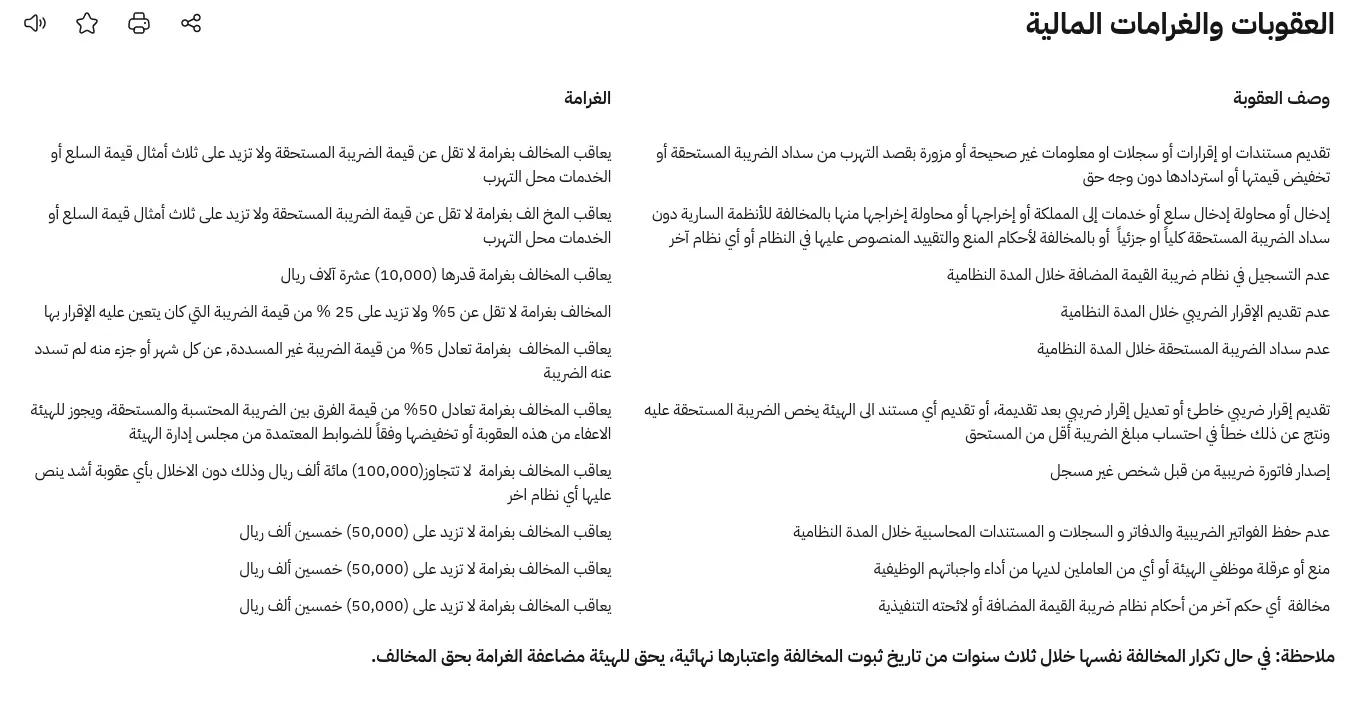
These are the fines published by the Zakat, Tax and Customs Authority under the VAT Law. Note that e-invoicing does not appear as its own row.
| Violation | Fine |
|---|---|
| Failure to register for VAT within the statutory period | SAR 10,000 |
| Failure to submit the tax return within the statutory period | Not less than 5 percent and not more than 25 percent of the tax that should have been declared |
| Failure to pay the tax due within the statutory period | 5 percent of the unpaid tax for each month or part of a month |
| Filing an incorrect return, amending a return after submission, or filing any document resulting in a lower amount due | 50 percent of the difference between the calculated tax and the tax due. The Authority may waive or reduce this penalty in line with the rules approved by its Board of Directors. |
| Issuing a tax invoice by a person who is not registered | Up to SAR 100,000, without prejudice to any stricter penalty provided in another law |
| Failure to keep tax invoices, books, records and accounting documents for the statutory period | Up to SAR 50,000 |
| Preventing or obstructing Authority employees from performing their duties | Up to SAR 50,000 |
| Violating any other provision of the VAT Law or its Implementing Regulations | Up to SAR 50,000 |
| Submitting false documents, records or returns to evade or reduce the tax due, or to obtain refunds unlawfully | Not less than the amount of tax due, and not more than three times the value of the goods or services involved |
| Moving or attempting to move goods in or out of the Kingdom without paying the VAT due | Not less than the amount of tax due, and not more than three times the value of the goods or services involved |
Where e-invoicing violations actually sit
This is the part that causes the most confusion. Because e-invoicing obligations come from the VAT Implementing Regulations, a failure to comply is treated as a violation of those Regulations. That places it in the general row: up to SAR 50,000.
Practically, that covers things like issuing invoices outside a compliant system, missing a required QR code, missing mandatory fields, failing to link with the Fatoora platform when your wave requires it, or altering an invoice after it has been issued.
Three things follow from this that are worth internalising:
- The ceiling is a ceiling, not a flat rate. Amounts are assessed case by case rather than applied automatically at the maximum.
- Some penalties can be reduced. For the incorrect-return penalty the Regulations explicitly allow the Authority to waive or reduce it under rules approved by its Board. That is a route worth knowing about before you assume a figure is fixed.
- Field-control violations are handled under a separate schedule. ZATCA operates a field inspection regime for e-invoicing with its own graduated approach. For exact amounts there, read the current field-control guidance directly rather than relying on secondary summaries, which frequently disagree with each other.
The repeat rule, and a correction worth making
Repeat violations can be penalised more heavily. The official wording is specific: if the same violation is repeated within three years from the date the violation is established and deemed final, the Authority is entitled to double the fine.
Two details matter here. First, a number of widely read Arabic articles state that the doubling window is twelve months. It is not: the window runs three years. Second, the clock starts from the date the violation becomes final, not from the date the original violation occurred. If you are assessing your exposure, both points change the answer.
The waiver initiative running right now
This is the most commercially relevant fact on this page, and it changes what you should do this quarter.
Following a decision by the Minister of Finance, ZATCA extended its initiative to cancel fines and exempt taxpayers from financial penalties for a further six months, running from 1 July 2026 to 31 December 2026. It applies to taxpayers across all tax systems.
What the initiative covers
- Late registration penalties across all tax systems
- Late payment penalties
- Late return filing penalties
- The VAT return correction penalty
What it does not cover
- Penalties related to tax evasion
- Penalties imposed under Article 45 of the VAT Law
- Penalties already paid before the initiative took effect
- Penalties linked to any return due after 30 June 2026
The cutoff most coverage misses
That last exclusion is the important one. ZATCA has stated that if the initiative is extended again beyond 31 December 2026, no subsequent extension will cover penalties tied to returns due after 30 June 2026.
Read plainly: the door is closing in stages. Historic arrears can still be settled. Obligations arising from July 2026 onward will not be waived, now or in any future round. Waiting for the next extension is not a strategy.
Conditions for benefiting
The exemption is not automatic. You need to be registered with the Authority for the relevant tax system, to have filed all returns that were due, and to have paid the full principal tax debt relating to those returns. Instalment plans are available, but the request has to be submitted while the initiative is still running, and the instalments must then be paid on schedule under the approved plan.
What to do before 31 December 2026
- Check for unfiled returns. Anything outstanding blocks you from the initiative entirely, and filing it now is what unlocks the waiver.
- Settle or schedule the principal tax debt. The penalty waiver does not waive the tax itself. If cash flow is the obstacle, apply for instalments before the deadline rather than after.
- Get compliant on e-invoicing now, not at your deadline. Obligations from July 2026 forward carry no waiver. A gap that would once have been forgiven no longer will be.
- Fix your records. Failure to keep invoices and accounting documents is its own violation with a SAR 50,000 ceiling, entirely separate from anything to do with filing.

Frequently asked questions
Is there a specific fine for not issuing an electronic invoice?
Not as a separate published line. It is treated as a violation of the VAT Implementing Regulations, which carries a ceiling of SAR 50,000. Field inspections are handled under a separate schedule.
Does the waiver initiative cover e-invoicing violations?
The earlier round of the initiative explicitly included field-control violations relating to e-invoicing provisions. The scope stated for the current round centres on registration, payment, filing and VAT return correction. Because this is the exact point where an assumption could cost you, confirm the current scope in the Authority simplified guideline for the initiative rather than relying on any summary, including this one.
Can a fine be doubled?
Yes, if the same violation recurs within three years from the date it was established and deemed final.
Can any penalty be reduced?
The incorrect-return penalty may be waived or reduced by the Authority under rules approved by its Board. Other rows do not carry that provision.
Does the waiver cancel the tax itself?
No. It cancels penalties. The principal tax debt still has to be paid, though instalments can be requested while the initiative is active.
Getting compliant
If the blocker is that your current system cannot handle Phase Two, that is a solvable problem and not a long project. Our step-by-step guide to connecting Odoo to Fatoora covers the full sequence, and the troubleshooting guide covers what goes wrong.
Back to the complete ZATCA requirements guide
This content is for general information and is not tax or legal advice. Figures and dates are drawn from published Authority material and are subject to change. Where the Arabic and English versions of an official page differ, the Arabic text governs. Always verify against the current official source before acting.